
Decoding the Language in Clinical Trials
This blog post explains how to understand the language used to describe clinical trials:
Breaking Down IntraBio's Trial Design
How Other Trials Might Look Different
Defining Success
Read the whole post below to learn more.
Week 2: Clinical Trial Education & Outreach Series
Once you start reading more about clinical trials, you may run into some unfamiliar language. This week’s post breaks down some of these terms so you can confidently read through a trial listing and understand what it’s actually describing.
As an example, we will walk through some of the language used in IntraBio’s listing for their upcoming clinical trial. Please note that not every trial is designed the same way. However, much of the language you’ll see is similar, so these definitions should carry over.
Clinical Trial Design
This Phase 3 clinical trial is described as a “randomized, placebo-controlled, double-blind, crossover, multi-center study…followed by open-label extension”.
Which can be a lot to take in all at once. So we’ll break it down term by term.
Randomized
Most Phase 3 trials split participants into two or more groups that receive different treatments (e.g. drug and placebo, an inactive substance made to look like the real drug) so comparisons can be made. Randomization means each participant is assigned to their group by chance. Neither the participant nor the research team gets to choose. This helps balance out any differences between participants, so if an effect is seen after drug administration, researchers can credit it to the treatment being studied.
How this may differ: In a non-randomized trial, researchers assign participants to groups deliberately, often based on traits like age or symptom severity.
Placebo-controlled
Including a placebo control group lets researchers separate a drug's real effect from something called the placebo effect. This is a well-documented phenomenon where people feel or report feeling better simply because they believe they're receiving treatment.
To isolate the investigational therapy’s true effect, researchers compare participants who receive the investigational therapy to those who are taking an identical, inactive substance (called a placebo).
How this may differ: Not every trial includes a placebo group. In an active-controlled trial, the investigational drug is compared against an existing, approved treatment instead. In a single-arm trial, every participant receives the active drug. Instead, outcomes are compared to an external benchmark, often data from a prior natural history study documenting how the disease typically presents.
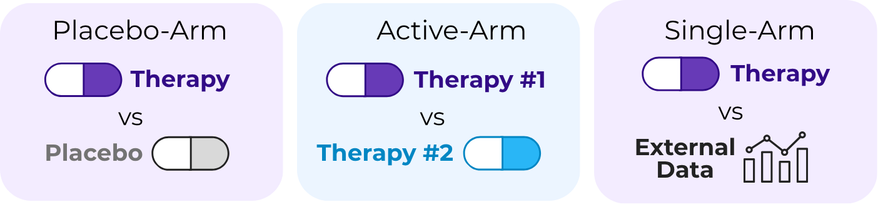
Both active-arm and single-arm trials show up more often in rare disease trials, where there may not be enough eligible patients to divide into multiple groups or where it would be unethical to withhold treatment.
Double-blinded
"Blinding" refers to who knows which treatment a participant is actually receiving. In a double-blind trial, neither the participant nor the research staff interacting with them know what they are taking until the trial is completed.
This helps prevent bias. If participants believe they’re getting the active drug, they might report feeling better simply because they expect to. And if a researcher knows which participants are on the active drug, that knowledge could unconsciously shape how they record or interpret the results.
How this may differ: In an open-label trial, both participants and researchers know who is getting what. In a single-blind trial, one side (usually the participant) doesn't know which treatment they're receiving; only the research team does.
Crossover
Rather than splitting participants into separate drug and placebo groups for the entire study, a crossover trial has every participant receive both the investigational drug and the placebo, just at different times. A participant will spend the first several weeks on the placebo, then "cross over" to the active therapy for the next several weeks (or vice versa).
How this may differ: In a parallel design, participants are split into groups and stay in their assigned group for the entire study, without switching.

Open-Label Extension (OLE)
Once the main part of the trial is complete, participants who want to continue taking the investigational drug can do so. This helps participants maintain access to therapies during waiting periods when data is being analyzed or under review by a regulatory agency. For those who served as the placebo group in a parallel design trial, this extension period is often their first opportunity to try the investigational drug.
How this may differ: OLE is not a guaranteed part of a clinical trial. It must be stated as part of the initial study design, and eligibility can depend on factors like how well the drug was tolerated and if it showed enough benefit during the main part of the trial.
How Success is Measured
Further down in a trial listing, you'll typically find the endpoints. These are the specific symptoms the study tracks and the assessments or measures used to determine if a drug is improving symptoms in a statistically meaningful way.
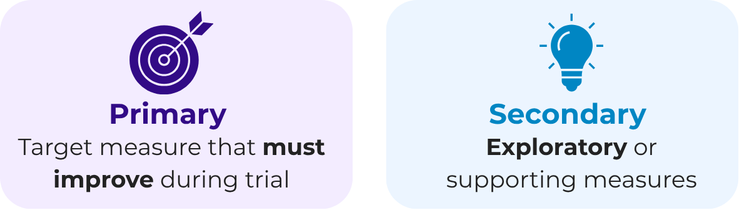
Every trial will have at least one main outcome (or primary endpoint). This is a change in a specific symptom or measure that the trial outcome relies on; it’s the make-or-break result. It determines whether the therapy is successful and moves forward, or doesn’t.
In our example trial, the primary endpoint is a noticeable improvement in ataxia using the SARA scale (a standard rating scale for ataxia severity). To move forward to regulatory approval, researchers need to see an improvement in ataxia with better SARA scores when participants are taking the drug than when they are on the placebo.
Secondary or ‘other’ endpoints are additional symptoms or outcomes the trial is also tracking. They aren’t the main focus, so a trial isn't considered a failure if one of these isn't met, but they may support the primary endpoint or inform future studies.
IntraBio’s trial lists several different secondary endpoints: surveys covering functional ability, clinician-and patient-reported impressions, quality of life, and seizure and migraine counts. Unlike the primary endpoint, these don't need to improve for the trial to succeed, but together they paint a fuller picture of how patients are doing beyond the ataxia scores alone.
Clinical trial language can look intimidating at first, but most of it boils down to a handful of recurring concepts: how participants are grouped, what they're compared against, and what counts as success. Once you recognize this, you can read almost any trial design and understand what's being tested.
Read the first blogpost in this series by visiting: https://www.cacna1a.org/blog/clinicaltrial1