Understanding Clinical Trials
This blog post goes over these parts of a clinical trial:
The Goal of a Clinical Trial
The 4 Phases of Clinical Trials
The Rare Disease Twist
Eligibility for a Clinical Trial
Read the whole post below to learn more.
Week 1: Clinical Trial Education & Outreach Series
This is the first post in our series on clinical trial readiness, and it starts with the basics: what a clinical trial actually is, and how something advances from a promising idea into a trusted therapy. Clinical trials are the required testing that determines if a new therapy is safe and it works. In practice, this means giving an experimental therapy to human participants under carefully controlled conditions and tracking what happens.
Protocols and Approval
Before a clinical trial begins, researchers come up with a detailed plan (called a protocol) that determines who can participate, what will be measured, and how long the study will last. Researchers must follow this protocol exactly once a clinical trial begins so that the results are trustworthy.
The protocol is reviewed and approved by an independent ethics board (an Institutional Review Board, or IRB) who makes sure the potential benefits of the therapy are worth the risks being asked of those who will enter the trial. IRB approval lets the study begin enrolling participants, but there are several study phases a therapy must pass through before it heads to the FDA for approval. Each phase of a clinical trial will have its own protocol, tailored to the question that phase is designed to answer, and each one goes through IRB review before it can begin.

Phases of a Clinical Trial
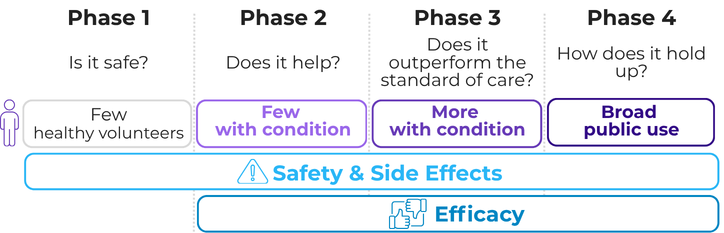
The different phases of a clinical trial may seem similar, but each is designed to answer a different question:
Phase 1: Is the therapy safe?
The first phase tests safety only, often in a small group of healthy volunteers.
Phase 2: Does the therapy help?
If no major safety concerns arise, the therapy moves into patients with the targeted condition to determine if it helps improve symptoms (or its efficacy). This is done in addition to continued safety monitoring.
Phase 3: Can the therapy outperform the standard of care?
In the next phase, a larger patient sample is enrolled. This is typically when the therapy is tested against either standard of care (what's currently being used) or a placebo (an inactive substance) to confirm its benefit. At this point, all data are compiled and submitted to apply for regulatory approval (in the US, this is to the FDA).
Phase 4 : How does the therapy hold up in the long-term?
Once approved, a treatment can be prescribed to patients with the condition it was tested in during early clinical trial phases. It will be continually monitored for rare or long-term side effects.
A note for CACNA1A families: This is the classic model, but rare disease trials don't always follow this pathway exactly. With small patient populations, researchers sometimes combine Phases 1 and 2, or avoid using a placebo-only group in Phase 3 (we’ll expand on this in Week 2). If a trial you're looking at doesn't match this textbook structure, it doesn't mean it’s any less rigorous.
Participating in a Clinical Trial
If you are interested in joining a clinical trial, begin by discussing options with your medical team or search websites like ClinicalTrials.gov, which list actively recruiting studies.
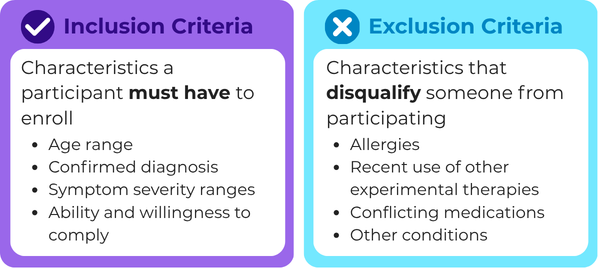
Once you find a trial that looks promising, the next step is understanding whether you or your child are eligible. Each trial will spell out exactly who can and can't enroll in their inclusion and exclusion criteria:
It can be frustrating to hear you or your child are excluded from a trial, but it’s important to understand these rules aren't about who's most worthy or in greatest need of treatment. They exist to make sure the study produces clear, interpretable results and to keep participants safe.
Inclusion criteria help to minimize the natural variation that exists between individuals, even those with similar genetic backgrounds. Because everyone's body responds to therapies a little differently, researchers need a way to separate effects of the treatment from differences caused by genetics, the environment, or other factors. By focusing the study on a more consistent pool of participants, researchers can be more confident that any changes they observe are due to the treatment being tested rather than something unrelated.
Exclusion criteria protect people from risks the study isn't equipped to manage, like drug allergies or a health condition that the trial isn't designed to accommodate. Similarly, if you are enrolled in a clinical trial, you may not be eligible to join a second trial at the same time because experimental therapies typically need to be tested one at a time.
Genetic Diagnostic Criteria
For CACNA1A-related disorders, clinical trials may require a confirmed genetic diagnosis, meaning you’ll need to provide a lab report showing the participant has a CACNA1A variant classified as Pathogenic or Likely Pathogenic.
Individuals with variants of uncertain significance (VUS) are sometimes excluded. This isn’t because they aren’t experiencing relevant symptoms, but because there isn't enough scientific evidence yet to confirm their symptoms are caused by a CACNA1A variant. Our understanding of genetics is always evolving, and VUS classifications can be updated as more research is done. If you don't qualify for a particular study today, it doesn't mean future studies won't be a fit.
Future Access
It's also worth noting that not qualifying for a clinical trial now doesn't necessarily shut the door on the therapy forever. Trial enrollment and long-term access to an approved therapy are two separate things. Once a therapy successfully receives regulatory approval, it can be prescribed more broadly–but only for the condition (or conditions) in which it was studied during the clinical trial. This is why it is so important to advocate for clinical trials to include people with CACANA1A-related disorders.
To learn about current clinical trials for CACNA1A-related disorders visit: https://www.cacna1a.org/clinicaltrials
To read the next blogpost in the series, Decoding the Language in Clinical Trials, visit: https://www.cacna1a.org/blog/clinicaltrial2